
Esports Industry in 2026: Market Size, Growth & Key Trends
It’s no surprise for anyone that the esports industry has seen tremendous growth in the last few years, both in terms of viewership count and revenues.
Esports now reach hundreds of millions of viewers and generate billions in revenue. The industry continues to expand in 2026.
Esports market in 2026
The global esports industry in 2026 has transitioned from a niche digital subculture into a mature multi-billion dollar media asset.
Defined by a total addressable market of over $5.34 billion, the ecosystem now rivals traditional athletic leagues in structural complexity, audience loyalty, and institutional investment.
| Market Era | Annual Valuation | Strategic shift | Leading titles |
| Professional foundations (2000–2010) | <$200 Million | Formation of leagues (MLG, ESL) and the South Korean “PC-bang” boom. | Counter-Strike (1.6/Source), Halo 2, StarCraft: Brood War, Warcraft III |
| The streaming boom (2011–2018) | ~$250M – $860M | Launch of Twitch; transition from TV to global 24/7 live-streaming. | League of Legends, Dota 2, CS:GO, StarCraft II, Overwatch |
| Market validation (2019) | ~$1.0 Billion | Fragmentation; first billion-dollar year; adoption of localized franchise models. | League of Legends, Dota 2, Fortnite, CS:GO, Overwatch |
| VC expansion (2020–2024) | ~$1.1B – $2.5B | Massive influx of non-endemic brands (Nike, Coca-Cola) and sovereign wealth investment. | Valorant, Mobile Legends (MLBB), Free Fire, League of Legends, PUBG Mobile |
| The mainstream era (2025–2026) | $5.34 Billion | Esports becomes a mature media asset, rivaling traditional sports in structural complexity. | Counter-Strike 2, Valorant, League of Legends, MLBB, Honor of Kings |
Where does the money come from?
The ‘Economic Engine’ of esports in 2026 is defined by a shift away from dependence on sponsorship. By diversifying into betting, mobile gaming, and exclusive media rights, the industry has built a resilient financial ecosystem:
- Sponsorships (39.9%): Generating over $1.2 billion, sponsorship remains the dominant pillar, though it has evolved from simple logo placement to deep in-game digital integrations.
- Media Rights (25.3%): Platforms like Twitch (holding a 47% share) and YouTube Gaming compete for exclusive broadcasting licenses.
- Esports Betting: Legalized frameworks have turned wagering into a massive vertical, projected to reach $2.8 billion by the end of 2026.
- Mobile & Handheld Gaming: Smartphones now capture 48.5% of total revenue, reflecting the dominance of mobile titles in emerging markets.
What is the Esports Market Size in 2026?
The global esports market is valued at approximately $5.34 billion in 2026, supported by a global audience of 640.8 million viewers and a shift toward mobile-centric gaming in the Asia-Pacific region.
How to watch esports?
Esports matches stream on platforms like Twitch, YouTube Gaming, and TikTok Live. These platforms host live tournaments, highlights, and player streams. Fans can join channels to follow their favourite teams.
Esports events are rarely shown on traditional TV. Streaming gives fans instant access from anywhere.
Stream viewerships
In 2026, the global esports audience is estimated to be 640 million, a significant jump from the 465 million recorded just five years ago.
- Dedicated Enthusiasts (318 Million): Core fans who watch professional matches weekly.
- Occasional Viewers (322 Million): Fans who tune in primarily for “World Finals” or “Majors.”
Regional Dominance: The Asia-Pacific (APAC) region is the undisputed leader, accounting for 57% of global viewership. China and the Philippines alone represent nearly 40% of the total global fanbase.
The history of esports
Spacewar Olympics
The first tournament at Stanford. Winner receives a Rolling Stone subscription.
StarCraft Released
Blizzard releases StarCraft: Brood War, which becomes the national sport of South Korea and the foundation of modern pro-gaming.
MLG Founded
Major League Gaming (MLG) is founded in the US, bringing console esports (Halo) to the Western mainstream.
League of Legends
Riot Games launches LoL, defining the MOBA genre and the future of free-to-play esports models.
Twitch.tv Launch
The spinoff of Justin.tv revolutionizes how fans watch gaming, ending the era of TV-dependency.
CS:GO Released
Valve launches Counter-Strike: Global Offensive. It remains the #1 tactical FPS in esports for over a decade.
Dota 2 Full Release
Valve officially releases Dota 2. Soon after, The International sets the first multi-million dollar prize pool records.
The Skin Betting Boom
Unregulated wagering via CS:GO “Skins” hits a $5B annual turnover, proving the massive demand for esports betting.
Overwatch & Mobile Legends
Blizzard releases Overwatch; Moonton releases Mobile Legends: Bang Bang, sparking the mobile esports explosion in Asia.
The Battle Royale Era
PUBG and Fortnite launch, introducing 100-player lobbies to competitive gaming.
PASPA Overturned
US Supreme Court allows legal sports betting, paving the way for regulated esports books like DraftKings and FanDuel.
Valorant Released
Riot Games launches Valorant during the pandemic, immediately challenging CS:GO’s FPS dominance.
Counter-Strike 2
Valve replaces CS:GO with CS2 on the Source 2 engine, modernizing the world’s most popular betting sport.
Olympic Esports Sanctioning
The IOC confirms the first Olympic Esports Games, providing the final layer of institutional legitimacy.
The $17.5B Maturity
Wagering turnover surpasses $17.5B as AI-driven live betting becomes a native part of the viewer experience.
What are the popular esports games?
League of Legends is probably the most popular esports today and has over 80 million monthly active players worldwide. Fortnite with 70 million monthly active players, takes the clear 2nd place.
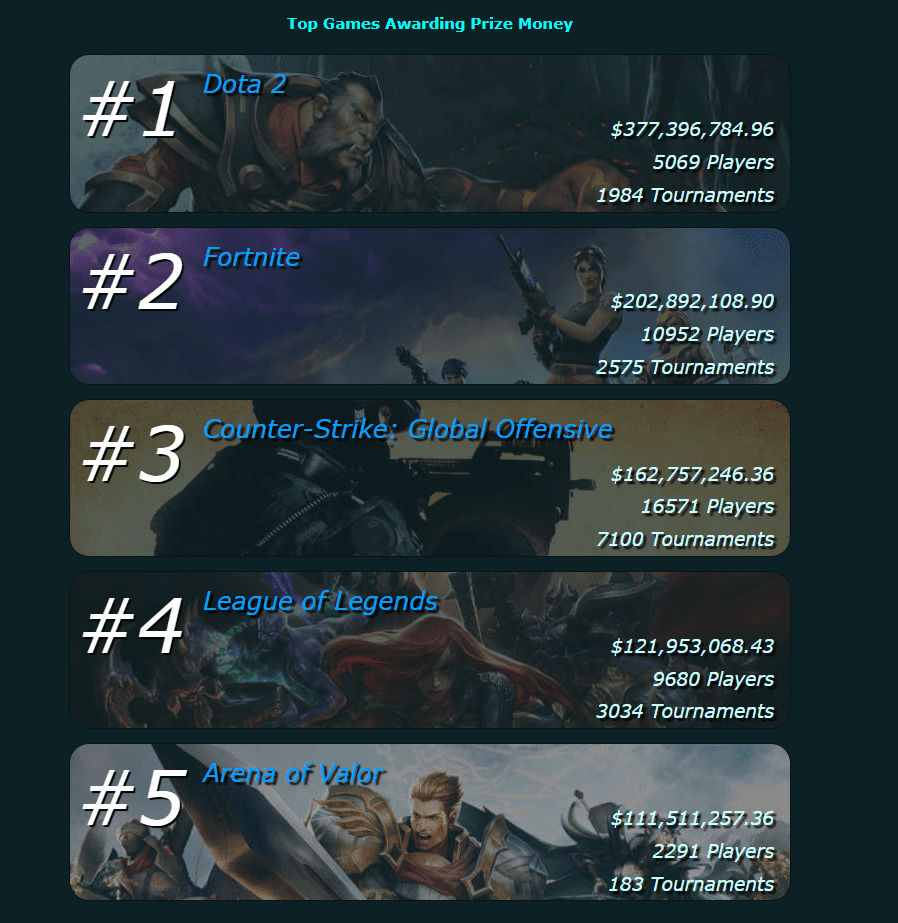
- Dota 2: The all-time prize money leader (over $377 million awarded).
- League of Legends: The “Viewership King,” peaking at 6.9 million concurrent viewers during World Championships.
- Mobile Legends: Bang Bang (MLBB): The leader in mobile esports, frequently outperforming PC titles in the APAC region.
- Fortnite: A cultural and financial powerhouse with over $202 million in historical prize distributions.
- Counter-Strike 2 (CS2): Holding steady with over $189 million, supported by a high-frequency tournament circuit.
The best esports teams
As of 2026, the highest-earning esports teams in history by total tournament prize money are:
| Rank | Organization | Estimated prize earnings | Core games |
| 1 | Team Liquid | $56M+ | Dota 2, CS2, SC2, LoL |
| 2 | OG | $38M+ | Dota 2 |
| 3 | Team Spirit | $35M+ | Dota 2, CS2 |
| 4 | Evil Geniuses | $28M+ | Dota 2, Valorant, CS2 |
| 5 | Natus Vincere (Na’Vi) | $24 Million | CS2, Dota 2, PUBG |
These totals reflect prize money only. They do not include sponsorship, merchandise, salaries, or media rights revenue.
The best mobile esports teams
As of 2026, the highest-earning mobile esports organizations by total tournament prize money are:
| Rank | Organization | Estimated prize earnings | Core games |
| 1 | All Gamers (AG) | $22.8 Million+ | Honor of Kings, Peacekeeper Elite |
| 2 | Wolves Esports | $18.9 Million+ | Honor of Kings, Identity V, PUBG Mobile |
| 3 | eStar Pro | $11.9 Million+ | Honor of Kings |
| 4 | Nova Esports | $10.5 Million+ | PUBG Mobile, Honor of Kings, Clash Royale |
| 5 | Team Weibo | $8.7 Million+ | Honor of Kings, Peacekeeper Elite |
These totals reflect prize money only. They do not include brand sponsorships, digital skin revenue sharing, or salaries, which typically account for the majority of a mobile organization’s total valuation.
The esports ecosystem
How does the multi-billion industry actually operate? Like any other sport, it requires several coexisting parts.
Without fans, there are no streamers or streaming platforms. Without viewers on the platforms, it would be pointless to organize leagues or events. Without leagues or events, there would be no interest in playing popular games as a pro.
And finally, without players, there would be no teams or games. And vice versa. All parts play an important role and enable the esports industry monetization.