
 CS2
CS2  Dota 2
  LoL
LoL  VAL
VAL  MLBB
MLBB  HoK
HoK  R6
R6  OW
OW  CoD
CoD  SC2
SC2  RL
RL 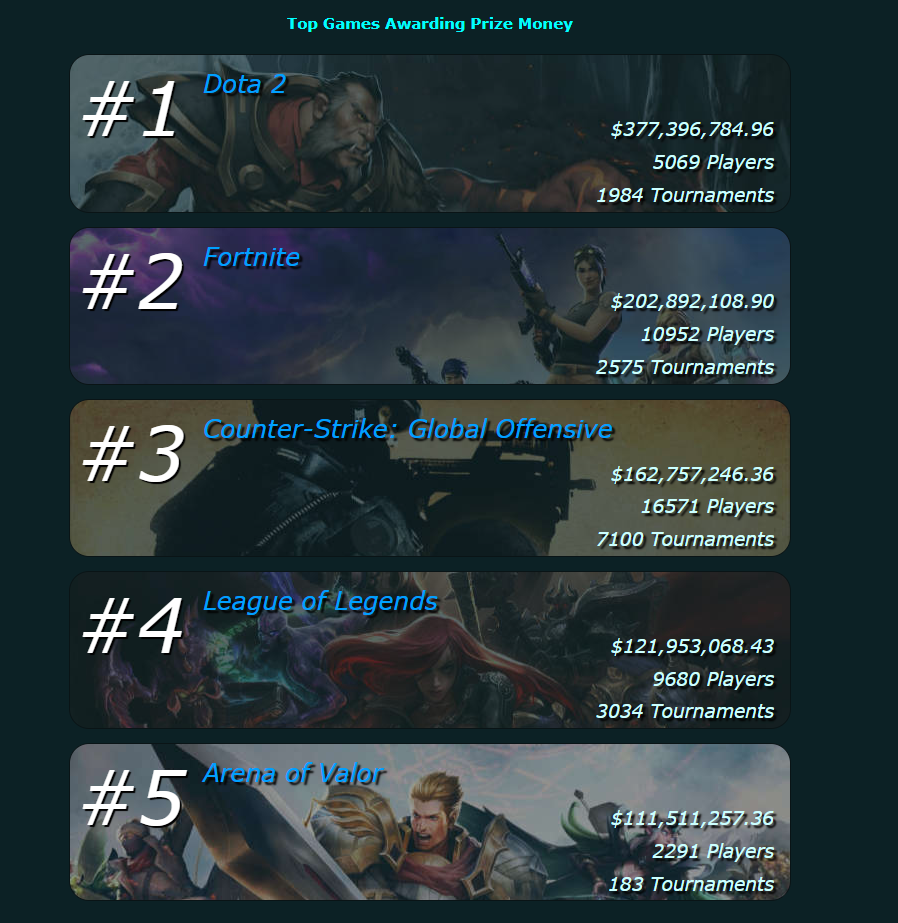
Esports (electronic sports) is competitive video gaming at a professional level. Teams and individual players compete in organized leagues and tournaments in games like Counter-Strike 2, League of Legends and Dota 2, for prize pools that range from a few thousand dollars to tens of millions. This guide covers what esports is, how the industry makes money, where to watch, and which games and teams matter. If you just want today's matches, start from the live scores or pick a game below.
Browse by game

Browse by genre
What is esports?
At the top level, esports looks a lot like traditional sport: professional players on salaried contracts, organizations that field teams in several games, coaches and analysts, regional leagues, international championships, and transfer windows. The difference is that the "sport" is owned by a company. The game's publisher (Riot Games, Valve, Blizzard, Ubisoft and so on) decides the rules, licenses the tournaments and can change the game itself with a patch, which is why competitive structures differ so much from one title to the next.
Some publishers run closed or partnered leagues (Riot's League of Legends leagues and the Valorant Champions Tour are the best-known examples). Others, like Valve with Counter-Strike, leave the circuit to independent organizers such as ESL, BLAST and PGL. That split explains a lot: an open circuit means more events and more upsets, a partnered league means stability for the teams inside it.
Biggest esports tournaments
- The International (Dota 2): the event that made esports prize money headline news. Crowdfunded through in-game purchases, its prize pool peaked at just over $40 million in 2021; Valve has since scaled the crowdfunding back, so recent pools are much smaller.
- League of Legends World Championship: the most-watched esports event in the world year after year.
- Counter-Strike 2 Majors: two per year, run by different organizers under Valve's sponsorship, each with a $1.25 million prize pool since 2025.
- Valorant Champions: the season finale of Riot's Valorant Champions Tour.
- Esports World Cup: a multi-game summer event in Riyadh, first held in 2024 with a combined prize pool of over $60 million.
You can follow all of these, and the regional leagues and qualifiers that feed into them, on our tournaments page.
The esports industry: market size and how it makes money
Esports has grown from LAN parties into a global media business, but it is smaller than the headlines sometimes suggest. Market research firm Newzoo estimated global esports revenue at roughly $1.4 billion for 2022, with an audience of a little over 500 million people. Estimates vary a lot depending on what is counted (some include betting turnover or game sales, which inflates the totals considerably), so treat any single "market size" number with caution.
| Era | What changed | Leading titles |
|---|---|---|
| Professional foundations (2000–2010) | First professional leagues (MLG, ESL) and the South Korean PC-bang and TV-broadcast boom. | Counter-Strike 1.6, Halo 2, StarCraft: Brood War, Warcraft III |
| The streaming boom (2011–2017) | Twitch and YouTube make every match watchable live, anywhere; publishers start running their own leagues. | League of Legends, Dota 2, CS:GO, StarCraft II |
| Franchising and investment (2018–2022) | City-based and partnered leagues, venture capital and big non-endemic sponsors; mobile esports takes off in Asia. | League of Legends, Overwatch, Valorant, Mobile Legends, Honor of Kings |
| Correction and consolidation (2023 onwards) | Investment cools, several franchise leagues are wound down or restructured, and state-backed events such as the Esports World Cup become major funders. | Counter-Strike 2, Valorant, League of Legends, Dota 2, Mobile Legends |
Where does the money come from?
- Sponsorship: by far the biggest source of revenue for teams and tournament organizers, from shirt logos to in-broadcast segments.
- Media rights: streaming platforms and, in some regions, TV networks pay for broadcast rights, though most esports is still free to watch.
- Publisher fees and revenue sharing: partnered leagues pay teams stipends or a share of in-game item sales (team stickers and skins, for example).
- Tickets and merchandise: live events in arenas and team jerseys.
Betting companies are also major sponsors in some games, particularly Counter-Strike, although rules on gambling advertising vary widely by country.
How to watch esports
Almost all esports is streamed for free on Twitch and YouTube, plus Kick and, in China, Bilibili, Huya and Douyu. Big events often have dozens of streams in different languages, and many leagues allow "co-streaming", where popular streamers rebroadcast the official feed with their own commentary. Esports is rarely on traditional TV outside a few markets.
On our match pages we list the available streams for each match, and show live viewer counts. Live scores update within a minute. Finished matches link to replays and highlights where we can find them.
Viewership
The League of Legends World Championship is the viewership benchmark: the 2024 edition peaked at about 6.9 million concurrent viewers according to Esports Charts, a figure that does not include Chinese platforms. Mobile titles such as Mobile Legends: Bang Bang regularly draw audiences in the millions as well, driven mostly by Southeast Asia. The Asia-Pacific region as a whole is the largest esports audience in the world.
The history of esports
- 1972 Spacewar Olympics Often called the first video game tournament, held at Stanford. The prize: a year's subscription to Rolling Stone.
- 1998 StarCraft released Blizzard releases StarCraft and its Brood War expansion, which become the foundation of professional gaming in South Korea.
- 2002 MLG founded Major League Gaming is founded in the US, bringing console esports (Halo) to a Western audience.
- 2009 League of Legends Riot Games launches League of Legends, which goes on to become the most-watched esport in the world.
- 2011 Twitch launches Justin.tv spins off its gaming section as Twitch, changing how fans watch esports. The first International awards a $1 million first prize the same year.
- 2012 CS:GO released Valve launches Counter-Strike: Global Offensive, the leading tactical shooter in esports for the next decade.
- 2013 Dota 2 full release Valve officially releases Dota 2, and The International begins crowdfunding its prize pool through in-game purchases.
- 2016 Overwatch & Mobile Legends Blizzard releases Overwatch; Moonton releases Mobile Legends: Bang Bang, a cornerstone of mobile esports in Southeast Asia.
- 2017 The battle royale era PUBG and Fortnite bring 100-player lobbies to competitive gaming.
- 2018 Overwatch League Blizzard launches a city-based franchise league, the high-water mark of the franchising model. It is wound down after the 2023 season.
- 2020 Valorant released Riot Games launches Valorant and builds its own international circuit around it from 2021.
- 2021 Record prize pool The International 10 awards just over $40 million, still the largest prize pool for a single esports event.
- 2023 Counter-Strike 2 Valve replaces CS:GO with Counter-Strike 2 on the Source 2 engine.
- 2024 Olympic and Saudi investment The first Esports World Cup is held in Riyadh, and the IOC announces plans for an Olympic Esports Games.
What are the popular esports games?
- League of Legends: the most-watched esport, with regional leagues in Korea (LCK), China (LPL), Europe and the Americas feeding into MSI and Worlds.
- Counter-Strike 2: the busiest circuit in esports, with an open ecosystem of independent organizers and two Majors a year.
- Dota 2: the all-time leader in prize money, thanks mostly to The International's crowdfunded prize pools.
- Valorant: Riot's tactical shooter, played in four partnered international leagues plus an open Challengers tier.
- Mobile Legends: Bang Bang and Honor of Kings: the biggest mobile esports, dominant in Southeast Asia and China respectively.
We also cover Rainbow Six Siege, Rocket League, Call of Duty, Overwatch, StarCraft II and Hearthstone.
The best esports teams
"Best" depends on what you measure. By all-time prize money, the leaders are long-standing multi-game organizations, mostly built on Dota 2 winnings. By current form, the answer changes every few months. Our power rankings rate teams by Elo, calculated from finished matches since July 2025, so you can see who is actually winning right now in each game. For roster moves, see the transfers page.
Some of the highest-earning organizations in esports history by tournament prize money:
| Organization | Where most of the prize money came from |
|---|---|
| Team Liquid | Dota 2 (The International 2017), plus CS, StarCraft II and League of Legends |
| OG | Dota 2 (back-to-back International titles in 2018 and 2019) |
| Team Spirit | Dota 2 (The International 2021 and 2023), plus CS2 |
| Evil Geniuses | Dota 2 (The International 2015) |
| Natus Vincere (NAVI) | Dota 2 (The International 2011) and Counter-Strike |
Prize money only. Sponsorship, salaries, merchandise and media rights are not included, and for most organizations they are worth far more. Live totals are tracked by sites like Esports Earnings.
Mobile esports organizations
Mobile esports has its own set of powerhouses, mostly Chinese organizations built on Honor of Kings and PUBG Mobile (sold in China as Peacekeeper Elite), whose leagues carry some of the largest prize pools in the region:
| Organization | Core games |
|---|---|
| All Gamers (AG) | Honor of Kings, Peacekeeper Elite |
| Wolves Esports | Honor of Kings, PUBG Mobile |
| eStar Pro | Honor of Kings |
| Nova Esports | PUBG Mobile, Honor of Kings |
The esports ecosystem
Like any sport, esports only works when several parts hold each other up. Publishers make the game and license competition. Tournament organizers run the events. Teams employ the players and sell sponsorship around them. Platforms and broadcasters carry the matches to fans, and fans' attention is what sponsors pay for. When one link weakens, as when investment pulled back after 2022, the effects ripple through the rest: smaller leagues fold, rosters shrink, and the scene consolidates around the games with the healthiest audiences.